

How fast will AI reach mass adoption and then start to lose its value for differentiation?
I was having this debate with a colleague recently. Im thinking its a couple of years. My colleague is thinking 7-8. Its a mute conversation in may ways, as it would be to hard to measure. That said, the wonderful bell curve and diffusion of of innovation theory gives us something to think about.
I was having this debate with a colleague recently. Im thinking its a couple of years. My colleague is thinking 7-8. Its a mute conversation in may ways, as it would be to hard to measure. That said, the wonderful bell curve and diffusion of of innovation theory gives us something to think about.
Consider these facts based on US market research from my friends AlphaROC:
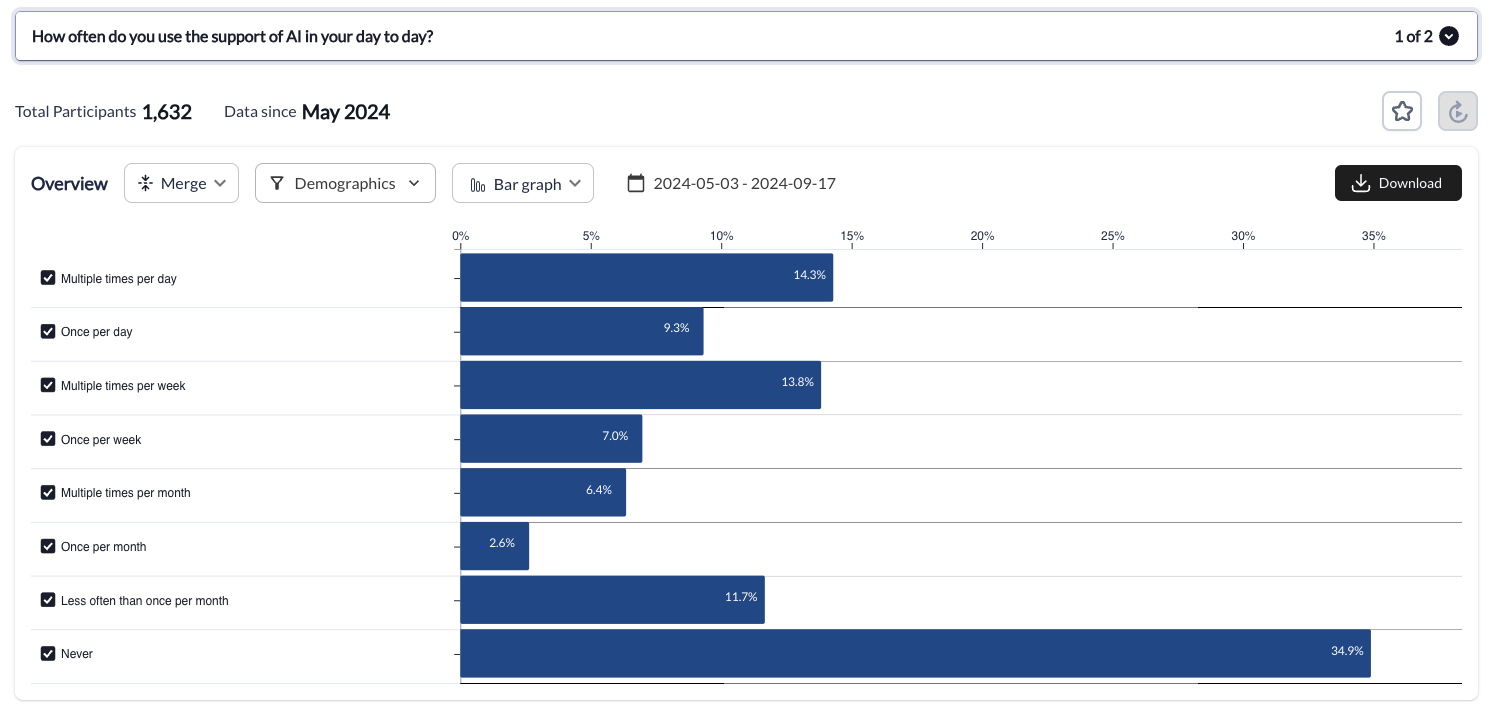
1. How often do you use the support of AI in your day to day? (n=1362).
* In September around 18% say "multiple times a day", up from 9% in early May
* Around 9% use it daily
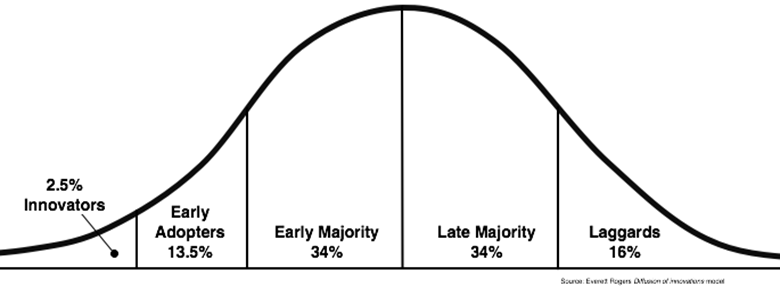
* And those that have never used it has dropped from 39% in May to 31% in Sep. That's ~20 basis points in 6 months. Based on that trend and accepting that 16% of people (laggards) will never really adopt having only 30% not using AI says to me we are moving fast.
Copyright AlphaRoc.ai
2. Are you aware of any of the following AI tools? n=11,730
* This month, ChatGPT awareness was 60%, Google gemini moving up to 42% and Microsoft Copilot around 20% and these sub-brands are but infants in the world. They will be as synonymous with every day life like Apple, Microsoft and Google before we can blink.
3. What are your thoughts on the current valuation and risk of AI-related stocks (e.g., Nvidia)? n= 1,022
* Around 32% of people feel stocks are Somewhat or Extremely overvalued. And when you take out the 40% of people that dont have an opinion, that suggests that over half of people with an opinion believe the market is over valuing AI stock...... my view of the AI bubble persists.
What do you think. will we be AI saturated sooner or later?

What defines a successful CMO today?
I was recently asked what I thought defines the idea CMO (Chief Marketing Officer) today. Reflecting on the question and response, I started to think that my 'limited' opinion might serve as good guidance for other marketers to consider. I also wonder what you think. #CMO #Marketing #data #intuition #branding #ChiefMarketingOfficer #creative #creativity
At a recent lunch with a fellow CMO and a leading Global Brand Strategist, I was essentially asked this question. Later reflecting on the question and response, I started to think that my limited opinion might serve as good guidance for all marketers to consider. I also wonder what you think, let me know in the comments.
I recognize there are many elements of a CMO’s capability and skills that are relative to the company, market and business goals. And, the role of a CMO is exceptionally diverse and complex. So for this discussion, I’m just focusing on a few that I think about and always look to improve.
Dynamic Decision-Making: A critical aspect I continually reflect on is the imperative to be action-oriented and efficient. CMO’s on average don’t have a lot of time for transformation. The Spenser Stuart CMO tenure study suggests, “The average tenure of Fortune 500 CMOs in 2022 was 51 months or 4.2 years, down slightly from 4.5 years in 2021. By comparison, the average tenure among CMOs of the top 100 advertisers was lower, at 3.3 years, largely due to the difference in size and composition of the two data sets.”[1] To thrive, a CMO must strategize proactively, monitor evolving dynamics, and adapt quickly, always aligning with both immediate results and long-term objectives like brand evolution. How do you approach decisions across different time horizons?
Balancing Data with Intuition: In today's data-saturated marketing landscape, the real skill lies not in data collection, but in how it’s used, the meaning that is drawn and the strategies it informs, not the data itself. So when you’re surrounded by data informed options and ‘answers’, I rely on intuition and experience to bring clarity and effectiveness. As Reed Hastings, founder and Chairman of Netflix, pointedly observed, “data didn’t tell us to create ‘House of Cards’ but it did help us get it to the right people.” The value of intuition and experience is often over shadowed by the power of rational data. As a CMO I seek to master the art of blending data-driven rationality with intuitive foresight to see compelling narratives and insight to optimize outcomes.
Championing Creative Leadership: If it’s not the CMO, who else in the C-Suite is going to be the champion for creativity and brand expression…. the CFO, the CHRO….? To me, creativity is a cornerstone of effective CMO leadership. It's about championing a creative spirit across the organization, as part of a culture to create space for self expression, ideation and the exploration of possibility. And don’t get me wrong, it’s not only the CMO that should value and espouse creativity, all leaders should. The CMO however, must be the beacon for a creative vision, inspiring and empowering teams to explore and realize potential advancements. How do you inspire creativity?
In conclusion, the role of a Chief Marketing Officer (CMO) today is multifaceted, requiring a dynamic blend of strategic foresight, data proficiency, and creative vision. While the specifics may vary across industries and companies, the core attributes of a successful CMO remain constant: the ability to act decisively, harness insights from data while nurturing our intuitive faculties, and lead with a creative spirit that permeates the entire organization. As the corporate landscape evolves, so too must the CMO, adapting and leading in ways that foster meaningful engagement and drive sustained growth. Your thoughts and experiences are invaluable—please share them in the comments below. Together, we can continue to refine our understanding of what it truly takes to excel in this challenging yet rewarding role.
[1] https://www.spencerstuart.com/research-and-insight/cmo-tenure-study-an-expanded-view-of-cmo-tenure-and-backgrounds

The CMO’s transformation challenge – Part 1
As the consumer landscape shifts, CMO’s seek to build better emotional connection with consumers and better brand experiences that provide a form of utility meeting a particular need, at a particular time.
This requires a primary shift in methods and often a re-creation of the marketing ‘system’ that CMO’s operate. Which consequently makes life more complex for the CMO.
Successfully conquering this complexity lies in the CMO’s ability to lead a transformed marketing approach.
Part one of the three-part series on the challenge to transform marketing for business growth
by Darren ‘Daz’ McColl, Marketing & Strategy Consultant – TARGAN CONSULTING
Understanding the CMO Landscape
According to Gartner, the average marketing budget is now equivalent to 12% of company revenue and 27% of that is allocated to marketing tech.[1] As a percentage, that’s about 5% more than the average allocation to media and just 1% less than what’s spent on marketing teams.
“Technology and data needs cannibalize media budgets. Marketers know that becoming more insights-driven will drive financial gain.. And more and more, media budgets fund investments in customer insights and the technologies to analyze and activate them. ”
At the same time, 31% of marketers say they have all the tools they need but don’t fully utilize what they have.[2] And, only half of CMOs regard themselves as effective at acquiring and managing tech.[3]
91% of CMOs are confident that Marketing will fundamentally change[4] and we can see the foundations of that today. As digital experience matures and customer engagement through digital commerce, social and digital channels becomes ubiquitous, consumers are returning their focus to product and brand value. And that focus is creating greater expectations for personal relevance and meaning in the way they are engaged, treated and how brands act within the wider world.
A couple of points to illustrate:
· Digital engagement in commerce is now ubiquitous (for example 83.2% of people in the US engaged in digital shopping, and 92% of them have done so with a mobile device)[5] – a sign that consumers are less likely to look at digital solutions in commerce as differentiating.
· Not only do consumers want businesses to be open and honest in their social posts, consumers actually hold businesses to a higher standard than they hold for themselves. In a new study from Sprout Social, consumers singled out brands as the group with the greatest responsibility to be “transparent” on social media, a broad term but one that the survey suggests includes honesty, openness, clarity and even authenticity.
As the consumer landscape shifts, CMO’s seek to build better emotional connection with consumers and better brand experiences that provide a form of utility meeting a particular need, at a particular time.
This requires a primary shift in methods and often a re-creation of the marketing ‘system’ that CMO’s operate. Which consequently makes life more complex for the CMO.
Successfully conquering this complexity lies in the CMO’s ability to lead a transformed marketing approach that is dynamic, performance driven and delivers customer engagement and communication that’s personalized and authentic, as well as solve their customers’ needs and problems responsively as things change. And of course, build emotional connection over time. All efficiently optimized for business growth through both customer acquisition and improved value.
That all leans to relationship building with individuals without getting ‘creepy’, that takes data, data management and creative application of stories and experiences throughout a customers’ individual journey of engagement. A hybrid approach that fuses motivational and behavioral data for fuller customer profiles is now essential. And that increases demand for insights that link customer data with business data which necessitates greater technical partnerships and investment.
And none of this is possible in a marketing team without a corresponding shift in mindsets, skills sets and processes. CMO’s need to make strategic changes around data and technology to support evolved brand and customer experiences, upskill their teams and relook at their processes to deliver more agile, creative and repeatable solutions.
Thus, it’s a clear and critical opportunity for CMO/CXO’s to create and implement transformation agendas for sustainable growth.
Establishing why a marketing transformation agenda is important
Marketing Transformation is fundamentally necessary for growth and profitability

Marketing today-- as it has been since invention—centers around consumer acquisition and retention to profitably grow a business. (Acquisition leaning to top line growth, retention leaning into lifetime customer value and profitability)
Marketing Transformation is likewise rooted in the concept of and focused on profitable growth. Quite simply in the marketing construct, if you want to just save money or cut costs, the easiest way is to simply do less and spend less. Thus, the ambition of marketing transformation is the evolution of: how you go to market, invest your budgets, operate your teams and systems, manage and leverage data, evolve products and experiences etc; all in service of growth and profitability from your efforts and spends.
“Every day, demanding customers, unforeseen competition, and disruptive new technologies hammer home that we have entered the age of the customer, where established business operations don’t work. Yet most marketing functions still rely on decades-old methods that undermine their ability to create post-digital brand experiences and help their firms become customer focused. CMOs: Because you behaviorally target ads or apply account-based marketing, you presume the customer is at the center of your marketing efforts. Au contraire!.“”
The industry and organizational challenge.
Many organizations’ marketing systems are built to produce and promote products or services. They are rooted in communication constructs and are often addicted to what has always worked, rather than a disruptive test and learn approach. They leverage systems and tools (like technology and media channels) to reach people, serve them with content, influence behavior or optimize investments. The primary construct of improvement is largely based on integration and performance efficiency (through better channel use or better asset use).
However, the power shift in marketing is the application of data and technology to both better inform and engage consumers at the speed of culture. Therefore, the modern marketing mandate must be to design and optimize the entire marketing system to acquire and retain consumers – by inspiring, rewarding, recognizing, and valuing them in ways that are personally meaningful and on their terms.
This can only be achieved when data is the fuel, enabled by the right technology, and the organizational design and incentive constructs of the past are changed to focus on and take advantage of these shifts.
It’s built on a belief that this will drive differentiation and desire, leading to growth and business value.
Time and speed are relative concepts business must deliver to.
Agility in technology could mean an enhancement release from sprint to live in 6 weeks…… a delay in delivery is leads to reduced business value. Agility in content marketing is moving from cultural occurrence to published in 6 hours…… a delay is the same as losing the entire consumer opportunity, as that live moment in a consumer’s world will have passed.
In Marketing today, there is no longer a “build and run” construct. Marketing is never “off”, it’s live and is constantly adjusting, adapting and evolving on the surface (consumer engagement and a brand’s content are both dynamic).
CMO’s need an approach designed to deliver on this reality – the speed of culture, and a responsiveness (or predictiveness) to the moment of consumer desire or need. The operational imperative to design and optimize marketing systems in this context also necessitates a transformed approach. Marketing Transformation in this dynamic universe requires more than integrated capabilities, it requires interdependence of diverse capabilities to be fluid and responsive. These capabilities must also be empowered to solve responsively and dynamically, using data and results as a strategic guide.
NEXT: Part 2
Delivering Marketing Transformation
[1] Forbes and Gartner
[2] Ascend2 - 2019 DIGITAL MARKETING STRATEGIES
[3] Gartner CMO Strategy Survey 2017
[4] Accenture
[5] eMarketer Oct2018

The CMO’s transformation challenge – Part 2
Part two of the three-part series on the challenge to transform marketing for business growth
by Darren ‘Daz’ McColl, Marketing & Strategy Consultant – TARGAN CONSULTING
Marketing Transformation is the design and optimization of marketing systems to deliver profitable growth. To achieve effective Marketing Transformation, the entire Marketing System must be redesigned and perpetually optimized. And in this instance I’m not suggesting just technology, but the end to end system for marketing from organizational role and approach to customer value (and its measurement).
Part two of the three-part series on the challenge to transform marketing for business growth
by Darren ‘Daz’ McColl, Marketing & Strategy Consultant – TARGAN CONSULTING
Delivering Marketing Transformation
Marketing Transformation - The design and optimization of marketing systems to deliver profitable growth.
Given the always active and dynamic nature of marketing there are a number of areas CMO’s can lead new impact. Some of them are:
· The systematic re-engineering of marketing tools, methods and approaches
· New marketing organizational constructs and operational capabilities
· Redesigning consumer and customer experiences for brand engagement
· The redevelopment of loyalty and retention programs
· The evolved management and application of data across systems
To achieve such transformation, no one dimension of marketing will suffice. Integration of data won’t deliver, nor will operational efficiencies through technology, and equally ineffective is singular experience innovation or enhancement.
“CMOs recognize that in order to be truly effective, storytelling must be transformed into a proactive content creation and marketing engine that is embraced as a vital business competency.“”
To achieve effective Marketing Transformation, the entire Marketing System must be redesigned and perpetually optimized. And in this instance I’m not suggesting just technology, but the end to end system for marketing from organizational role and approach to customer value (and its measurement).
Recent research and analysis of CMO’s, marketing consultancies and research houses illustrates that the transformation of marketing to the modern aspiration is driven through three primary dimensions of modern marketing. This doesn't negate the value or importance of other marketing dimensions like; price, value and offer management, or the inherent value of brands it’s a focus of “Marketing Transformation” where systematic changes are most impactful.
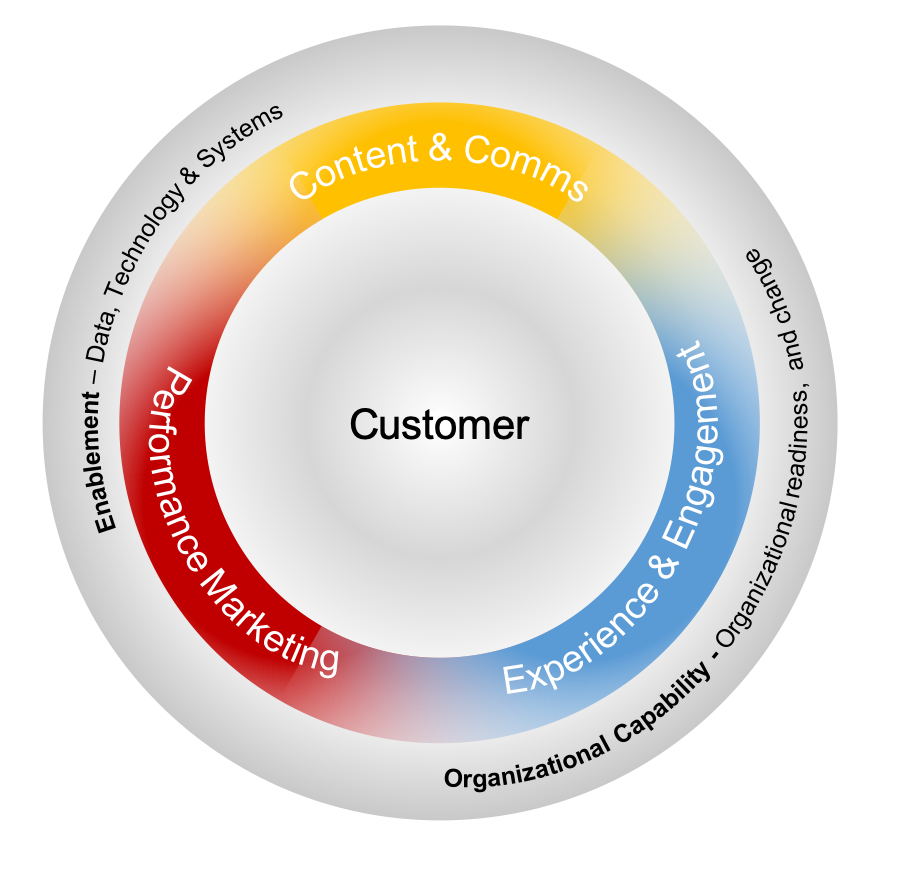
The primary areas of focus and impact are:
1. CONTENT & COMMUNICATION
2. PERFORMANCE MARKETING
3. EXPERIENCE & ENGAGEMENT
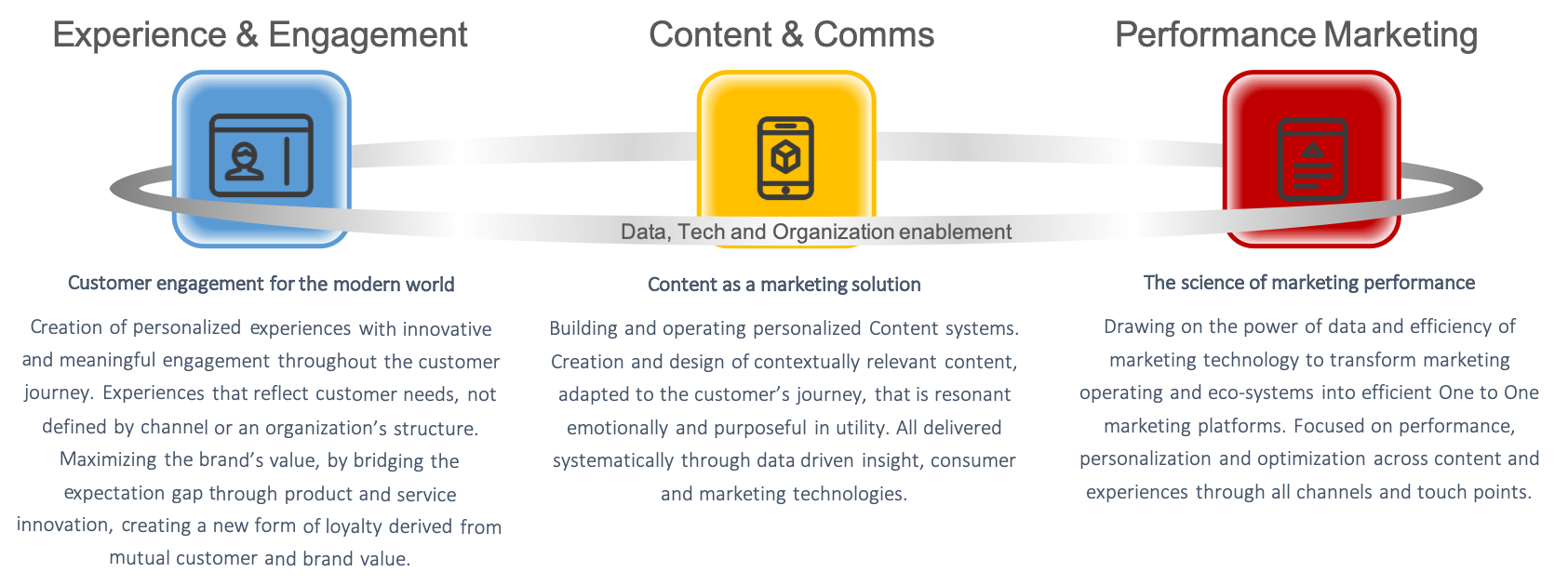
The dimensions or focus areas should be seen as integrated characteristics of marketing and not necessarily teams or vendor services. And, each is fundamentally and critically enabled by technology, data systems and organizational capabilities. Without the application and evolution of these ‘enablers’ as applied to the focus areas, there is no transformation.
Each of these focus areas for marketing transformation (further detailed below) can derive a “transformative step” along the transformation agenda. Collectively they achieve progressive marketing transformation over time when enabled through the strategic application of technology and data. And internally supported by organizational change as needed.
A journey of systematic leaps
As Marketing doesn’t stop, I believe that transformation is best delivered through a series of ‘systematic leaps’. Each leap is a significant change in how a business operates that has meaningful impact on growth and measurable business value. It’s more than improvement, requires planning, investment and organizational adaption. Inherently with any ‘leap’ there is some risk, but as business and consumer expectations are moving in a fast and fluid fashion, the greater risk is to not leap when you have a chance.
These leaps may be developed from one or more focus area at any one time. They are also in context of marketing organizational change and impact, either organically or strategically. Over time these leaps are defined and prioritized for greater business value.

Next: Part 3 - What it takes to transform - Capabilities, Structure, Mindset

THE CMO’S TRANSFORMATION CHALLENGE – PART 3
The capabilities to deliver marketing transformation are diverse and interdependent.
What you also need to appreciate and explore is the application of these capabilities – and no, that isn’t solved by the creation of a PMO. All too often I have seen the creation of a PMO as the panacea for transformative change and while important as a management construct, it doesn’t replace great leadership, culture and the flexibility to evolve on the fly. So please, don’t fall for the trap of trying to project manage yourself into a transformation.
To set perspective, I look at three core dimensions of people application: The capabilities, structure and mindset.
The three part series on the challenge to transform marketing for today’s consumers and business
What it takes to transform - Capabilities, Structure, Mindset
The capabilities to deliver marketing transformation are diverse and interdependent.
When you look at the specific and functional programs behind these transformative steps, you will either imagine you have resources or, you will imagine you have nothing of what is needed and desire a complete overhaul. Like most binary decisions in the marketing world, both are part wrong. And the answer isn’t to just add an agency on as a supplier to deliver the functional development needs.
If you really aspire to marketing transformation, you need to leverage existing knowledge with new insight and perspective. And will you will quickly realize there’s a need for a very diverse mix of capabilities, some you would not instantly expect or recognize. And that’s all part of shaping your marketing system for more progressive methods and solutions. The specifics of a project and organization will dictate the obvious people needs like; experience designers and the expertise of technology architects etc. Many of these will be in place, but you must also open up to greater diversity in thinking and perspective. And that means opening up and bringing in new capabilities, talent and thinking.
““If you do tomorrow what you did today, you will get tomorrow what you got today.””
Remember the old Ben Franklin line….. Same applies for using the same people. It’s hard to transform from within. It’s hard to transform from outside. Blend the two. Explore different angles, even if for part of the journey. For example, have you considered hiring an organizational culture specialist, or a marketing science expert? What about an anthropologist or cognitive neuroscientist? Injecting diverse expertise to challenge your marketing teams, analyze systems and understand consumers from new perspectives can certainly be disruptive, but that is the very nature of transformation, otherwise you are just optimizing.
What you also need to appreciate and explore is the application of these capabilities – and no, that isn’t solved by the creation of a PMO. All too often I have seen the creation of a PMO as the panacea for transformative change and while important as a management construct, it doesn’t replace great leadership, culture and the flexibility to evolve on the fly. So please, don’t fall for the trap of trying to project manage yourself into a transformation.
To set perspective, I look at three core dimensions of people application: The capabilities, structure and mindset.
Capabilities
This is the collective set of people skills, experience and tools to enable the change and evolution of the marketing system. As discussed above, diversity is key – in all forms, background, experience, perspective, opinion. Think about your current team, how can that be augmented for even greater diversity in perspective and skills
Structure
Structure should provide for efficiencies and also to give people connection. Note, it’s not about authority and order but connection and a sense of place. Flexibility should be built in the same way accountability should be clearly defined. When people know what is expected of them, and there is flexibility to adapt because the structure supports transformation, great people will flourish and drive progress. They will also feel well connected to the transformation and not a victim of it. All of which generates greater and better outcomes for the business and its’ people
Mindset
It’s believing in and creating a culture of leadership mutuality. An openness and transparency where people are inspired to lead no matter their position or role. A failure is an option logic. A collaboration is the only way forward approach. A kaizen spirit for incremental always on improvements.
To get all of this working together you need two more dimensions. One, is a defined transformation leadership team. An “LT” that is accountable, collaborative and cross departmental. You cant change marketing ins a silo, its central to customer experience, which is a whole of company premise. So create a connected team with leads from IT, HR , sales, finance etc. Second, create a plan. Prioritize, the steps, the scope and the objectives of each step with accountable ROI measures and goals. Build in a means to evolve and adapt the plan as internal and external forces re-shape the operating and consumer landscape.
In conclusion
CMO’s are faced with three fundamental and profound forces; the growing complexity of marketing systems, the ever increasing expectations of the consumer and a continual need for growth. The consequence, is in some cases a dire need to transform the marketing operation to make sizeable sustainable improvements to strengthen the business in the face of competition. The areas of greatest marketing impact are content and communication, experiences and performance marketing, all of which are driven, enabled and fueled by new and emerging technology systems and data capabilities. Fundamental and transformative change can also be disruptive on organizational capability, culture and effectiveness. Therefore, a transformation should be seen as a journey of key steps, tuned to the organizational change and capability readiness and to minimize the risk of negative growth impacts.
Individually CMO’s, often lack the breadth of skills and experience of some dimensions in the more complex tech and data enabled marketing construct. As such, it is key that a diverse (in skill, perspective and background) leadership team be formed to manage and lead the transformation. Additionally, CMO’s need to establish key partnerships for the transformation across the organization especially with core capabilities like marketing strategy, IT and HR.
Establishing a transformation program that is designed to be agile and flexible to capitalize on market and technology changes will support currency and efficiency. Such a program, engaging diverse teams and vendors transparently and effectively, will support a more effective transformation leading to growth.

Memories Mean Business
It’s useless to create stories that no one remembers; you can’t change perceptions and drive behaviors (or commerce) that way. In the sea of channels, posts, pins, videos, etc., there’s a real value in understanding the way our brains create memories.
My fascination with how the brain works, is mostly that, a fascination and a bit of a hobby. So, while I am certainly no Cognitive Neuroscientist, my interpretation of how to parlay what I’ve learned about the brain into marketing strategy has really helped me—thought I’d share it, in hopes it will help you too.
We must first recognize and work from the fact that people learn more from experiences than we do from stories alone. That point is validated by the findings from cognitive neuroscience studies on how memories are created.
Go for the senses! Participation in an experience is far more likely to produce a stronger memory than a story that is just seen or heard. Physiologically, that’s validated because experiences are multi-sensory. If you touch something, smell it, hear it, interact with it and it responds to you, your likelihood of remembering that exchange is significantly higher than if someone just told you about it. If you are in it, part of it, and it’s emotionally charged, retention is higher. Period.
Now, just because a person experiences something in a multi-sensory way, and likes something doesn’t necessarily mean they are going to buy the product or service associated to that experience. The goal is to re-trigger and reinforce the memories experiences create. The connection needs to be stimulated by a need or a point of engagement that inspires a behavior change.
From a marketing point of view, in a world of competitive environments, it goes beyond one on one, in the moment, direct distribution. You need brand recognition and recall that comes from the fact that people had a great experience with your brand. But their recognition won’t increase if they don’t have an association with the brand.
For example, I was recently at a conference and observed the layout of little food and refreshment stations throughout the event space. The refrigerated drinks were housed in a Coca-Cola cooler, and while there was a small section of Coca-Cola products, the remaining selections were lesser known brands that vendors wanted us (a collective group of influencers) to sample. It was interesting to observe what happens when people are confronted with a bunch of unfamiliar brands—they just stood there, looking very inquisitively at these unfamiliar options. Because there’s no recognition, there’s no simple way for your brain to say ‘I’m thirsty, I want a drink, I am going to have X, because I know what X is, and it suits my need.’ For me, it was an interesting sample experience, but a bad brand experience because I had no way of discerning, because I had no recognition to draw from. Good marketing should help solve for this by building awareness and memories.
This example reinforces why you can’t just create a product and make it available. It’s why creating experiences (not just stories) is so important. Unless the story is immensely powerful and connects in a very emotive way, it’s challenging to achieve recognition. Always aim to make marketing into memories, because memories mean business.

Frequency, Recency and Relevancy - some tips
Before we weigh in on whether the path of frequency, recency or relevancy being more important for propelling your brand’s world, I ask that we first come from a new starting place.
Tip #1 - Today, we must recognize that the consumer is in control, so we need to better understand them.
And while consumer expectations are on the rise, an approach of constant disruption, is not a good solution.
Okay, that being said, I’ll dip right into frequency. Frequency is simply the amount of times a person sees your message. Some people think that more is better, right? Seems logical to think that frequency builds greater brand awareness, which eventually leads to a boost in sales over time. Well, thanks to tip #1, we need to evolve our thinking around that concept. Here’s an example.
When I think about the frequency game, frustrations with some banks are top of mind. I’d really like Capital One to promise me that if I sent in just one response to their sea of solicitations, they would stop sending me 10 per week. Really, how many pieces of mail do they send before realizing which consumers are never going to take out a credit card with them? Here is where I wish brands paid attention to the measurement of ‘no response’. Even though consumers can’t really expect high relevancy from brands that don’t know who they are, they can expect that brands pay some attention to non-response.
Tip #2 - Brands can get to know someone by their lack of response. If after 150 mailings over 200 days, there isn’t a response, it’s a fair bet they are not going to respond, so why not give that address a break for 12 months and then try again? Banner ads are the same; how many times do people have to see and not respond to the same banner ad before the brand knows you are not going to click on it?
Yes, frequency can help breed familiarity. Think about the people that you meet online. You might not really know them, but because of the frequency with which they pop up, they start to feel familiar, and over time you naturally begin to feel somewhat invested in them and thus, more open to them if they were to reach out to you. If brands were people, it would work in a similar way, right? But brands must take some care in employing frequency without regard to relevancy.
Tip #3 - Relevancy matters in all forms of marketing. Consumers are getting accustomed to being told by brands that they care about us—when content and advertising isn’t relevant, it risks a negative effect.
The growing consumer expectation of ‘relevance’ is far out pacing brands’ ability to deliver on it. The ad tech companies will tell you that isn’t true, but we see some brands are doing it well, while the others that are not evolving, are shooting themselves in the foot.
Now, let’s touch on recency. I imagine recency as being a bit more actively cognitive in nature—it’s a person’s ability to recall something, based on the most recent message. For example, I just met five people, but I can only remember the name of the last person. Or, I’m hungry and driving down highway, over the last several miles I passed numerous restaurant billboards, but because McDonalds was the most recent, I will go there.
Tip #4 - Targeting based on relevancy helps win in the game of frequency and recency.
Take Dollar Shave, Amazon, Zappo’s, Domino’s—these brands are effectively working the relevancy, frequency and recency angle. Think about when you’re exploring on Facebook, you’re playing in the world of people, and a few good ads—which are sharply relevant to you—are served up, so relevant and so fresh amongst everything else that they stand out. I’m pretty sure that it was Dollar Shave ads on Facebook that got me to sign up.
On the flip side, I would like Citibank and American Express to recognize that I already have a business card from them, and therefore, I don’t actually want another one. Unlike Capital One’s generic machine gun efforts, these two banks actually have access to more personal information about me; so, I’d appreciate it if they used it to communicate with the relevant departments.
Continuous solicitation for something I already have makes me doubt my relationship with them. Beyond being annoying, it sends a message that they don’t care about me. It would be like knowing you’ve got customers who are vegetarian, but choosing to bombard them with ads for steakhouses. Not cool. But eating vegetables frequently is cool.

Big Ideas Are Made Better by Organizing Ideas
Most of us have worked to either help come up with that awesome ‘big idea’ or perhaps support a big idea after it’s been created and sold. The purpose of a big idea is to get consumers to look up and think, “Wow, that’s amazing!” So, of course this is still a necessary component in marketing today.
Storyscaping helps pinpoint a new type of idea that has the ability to help define how your brand interacts with the consumer. We call it an ‘Organizing Idea’ and one of its main purposes is to organize the connections between the consumer and the brand story in a way that builds emotional association and inspires behavior. Think of it as an idea you use to curate your content and tactics around. It’s an idea platform to consolidate your communications plan, experiences and actually drive your entire strategy. An Organizing Idea acts as the script by which your players (employees, vendors, partners, stakeholders and consumers) follow - it directs them on how to best contribute to the whole project, bringing new ideas and experiences.
““an Organizing Idea should help guide the construct of the experiences””
We dig deep to gain insight into consumers because insights give us a way of looking at and expressing an emotional territory that we may be able to bridge between a brand and a consumer. The role of an Organizing Idea in relation to insight is that an Organizing Idea should help guide the construct of the experiences that help build a brand-consumer relationship and an emotional connection. But realize, an Organizing Idea can't do that on it's own because it's not something a consumer connects with -they can connect with the experience that we build around the Organizing Idea.
The right Organizing Idea is something that helps you to say, ‘ok, I can understand how we can tell a story about that, how I can build an in-store experience against that, what we’re going to do in social around that, what we’re going do with ads, what sort of site and experience we are going to create, and I can even confirm that we have the perfect big idea.’ With the right Organizing Idea you’re able to keep focused and aligned. You will continually recognize that there must be one strategy - rather than a strategy for social, a strategy for events, a strategy for digital, a strategy for public relations. No,there’s just one and it’s all directed by the Organizing Idea. An Organizing Idea is a strategic input and sometimes, it may also be a creative expression. Even the very premise of what content you create, curate, or associate can be enhanced by leveraging it against an Organizing Idea. It’s a powerful concept that unlocks great effectiveness in how your story is told, delivered, engaged with, and experienced.
These are brief descriptions for the reasons why we consider the Organizing Idea to be a key to unlocking the power of Storyscaping and successful marketing. For more in depth discussion and examples of effective Organizing Ideas, read Storyscaping - Stop CreatingAds, Start Creating Worlds.